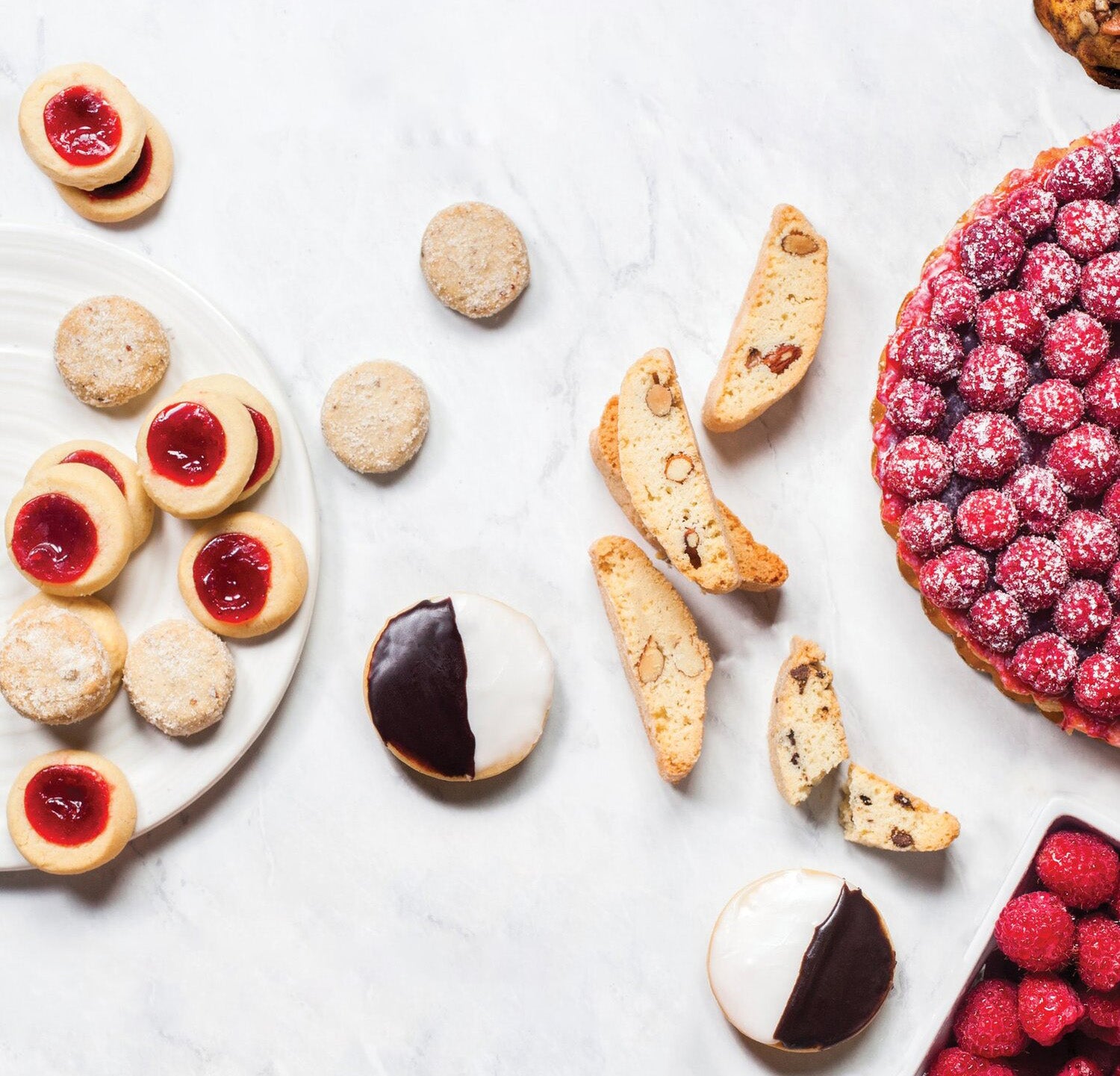


Walk down any grocery aisle and you’ll find shelves lined with cookies promising nostalgia, indulgence, and “homemade” flavor. But there’s a reason bakery cookies taste different and it has nothing to do with branding or packaging. The difference comes down to how they’re made, what goes into them, and what they’re designed to be.
At William Greenberg Desserts, baking has always been about craft over convenience. For generations, our cookies have been made the traditional way: in small batches, with real high quality ingredients, and with an attention to detail that mass production simply can’t replicate.
Here’s what truly separates bakery cookies from mass-made ones.
Ingredients: Fewer, Better, and Chosen for Flavor
Mass-produced cookies are formulated for shelf life. That often means preservatives, stabilizers, and fats chosen for consistency rather than taste.
Bakery cookies start from a different place entirely.
At William Greenberg, our ingredients are selected for flavor and performance like real butter, quality European chocolate, fresh nuts, and time-tested recipes that don’t rely on shortcuts. The result is a cookie that tastes clean, rich, and balanced, rather than overly sweet or artificially uniform.
You can taste the difference immediately.
Texture: The Hallmark of Real Baking
Texture is where bakery cookies quietly stand apart.
Mass-made cookies are engineered to survive months of storage and transport. That usually means firmer textures, uniform density, and a sameness from bite to bite.
Bakery cookies, by contrast, are baked to be enjoyed fresh. Some are tender and crumbly, others crisp at the edges and soft at the center. That variation isn’t a flaw, it’s a sign of real baking, done by hand, in real ovens. Take our classic butter cookies, they are made this way to be rich and textural.
At William Greenberg, that balance of texture is intentional and closely guarded. It’s what gives each cookie its character.
Shelf Life: Freshness Over Longevity
Shelf life is one of the clearest differences between bakery and mass-made cookies.
Packaged cookies are designed to last for months. Bakery cookies are made to be enjoyed at their peak. That’s why they’re baked in smaller batches, packed carefully, and shipped fresh rather than stored indefinitely.
The shorter shelf life isn’t a drawback, it’s proof of quality. It means no preservatives, better ingredients, and flavor that hasn’t been engineered to survive a warehouse.
Flavor Depth: Where the Difference Really Shows
Mass-produced cookies aim for consistency. Bakery cookies aim for flavor and depth.
In a bakery cookie, you taste layers: butter, sugar, flour, spice, nuts each contributing something distinct. The flavor develops as you eat it, rather than hitting all at once.
Our cookies are built around this idea. Whether it’s a pecan sandie, or a classic Black & White, the flavor is deliberate, balanced, and the texture unmistakably made by hand.
Why This Still Matters
In an era of shortcuts and scale, bakery cookies represent something increasingly rare: restraint, patience, and respect for tradition. It's why our gift tins always surprise and delight our customers whether they are our gorgeous Italian Rainbow Cookies or freshly baked Chocolate Chip they are always well - received.
William Greenberg Desserts has never tried to compete with mass production. Instead, we do what has always done - bake carefully, use excellent ingredients, and let the product speak for itself.
That’s why the difference is easy to taste. And why, once you’ve had a true bakery cookie, like ours, it’s hard to go back.